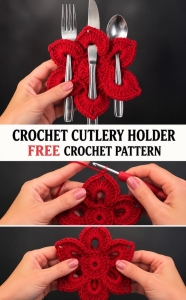
Welcome to Grandma’s Crafts! I’m so happy you are here today. This Flower Cutlery Holder Free Pattern is a floral table accessory with six open petals surrounding a small circular center. Its charm comes from those generous openings, which frame the cutlery rather than covering it with a solid piece of crochet.
I love a table decoration that lets the shape of the crochet do the work. Here, the petals curve around the utensil handles, while the little pointed tips finish the flower’s outline. The openings are part of the design and should remain visible in the finished piece.
Blue gives this flower a lovely presence beside simple dishes and pale table linens. If you prefer a different shade, let your existing place settings guide the choice. Keeping the flower in one color makes its outline especially easy to appreciate.
Below, the construction stays in three written stages. There is no extra foundation round, separate leaf, or added pocket. Read all three stages before beginning, and keep the flower’s open shape in mind as you work around the center.
A Closer Look at the Design
The petal openings are the important feature to notice. These are not solid leaves with small rings attached at their ends. Each petal has a broad opening framed by stitches, with a small decorative point on the outside edge.
The cutlery sits through the larger petal openings. Those openings should not be confused with the small loops at the tips. When choosing a photograph for your project notes, look for the same hollow-petal construction so you can compare the overall shape meaningfully.
The written sequence begins at the center, establishes six arches, and finishes those arches with the petal stitches. Keep these stages together. Adding another round between them would change the construction rather than simply explain it.
Materials
Blue crochet yarn.
A crochet hook identified as number 5.
Scissors.
The hook designation is retained as given, without converting it to a millimeter size. Hook numbering systems differ, so a number alone should not be treated as a confirmed millimeter measurement. Check the marking on your hook and the sizing system used before choosing your equipment.
No particular fiber, yarn weight, yardage, gauge, or finished measurement is specified here. Keep the label from whichever yarn you use so you have its care information available later. If you plan to make a matching set, record your yarn and hook details from the beginning.
Stitch Terms
The instructions call for double crochet, single crochet, slip stitch, chains, and the term “regular crochet stitch.” Double crochet and single crochet are different stitches in US terminology and should not be treated as interchangeable.
The expression “regular crochet stitch” is not defined in the written directions. It is retained below rather than silently replaced with single crochet, double crochet, or another stitch. Its meaning needs clarification before these directions can be treated as a fully executable US pattern.
For the familiar terms, a chain is made by drawing the yarn through the loop on the hook. A slip stitch draws the yarn through the indicated entry point and the loop already on the hook. Work these gently so the fabric is not pulled tight unintentionally.
Flower Cutlery Holder Pattern
Work with the blue yarn. These three stages retain the stitch quantities and sequence of the supplied instructions, with no added round.
Row 1: Start with a magic ring. Place 12 double crochet stitches inside it, with one chain separating consecutive double crochets.
Row 2: Work one regular crochet stitch over the preceding stitch, then an increase into the chain space. Make 12 chains and work six regular crochet stitches. Continue this sequence until there are six arches, each containing 12 chains, separated by groups of six regular crochet stitches.
Row 3: Use a slip stitch to reach the middle of a six-stitch group. Work two single crochets. Fill the chain arch with 15 double crochets, five chains, and another 15 double crochets. Close at the middle of the six-stitch group with two single crochets. Repeat around all six arches.
Check the Repeated Parts
Before moving from one stage to the next, look at the repeated features that are explicitly named. The opening stage calls for 12 double crochets separated by chains. The next stage calls for six chain arches, and each arch contains 12 chains.
For the petal stage, count each group of 15 double crochets separately. Keeping track of the two groups is easier than trying to judge their fullness by eye. The five-chain section sits between them and should remain distinct from the larger arch underneath.
Do not use these checks to fill in unspecified instructions. In particular, the written directions do not establish a complete stitch total for every stage or explain the increase in detail. A new stitch total or an invented increase sequence would create a different set of directions.
Keep the Open Petals Visible
When looking over the work, pay attention to the spaces as well as the stitches. A photograph of a solid six-leaf flower cannot show the same structure as this open-petal holder. A flower with a rectangular pouch attached is also a different project.
The small outer points should not be used as substitutes for the large petal openings. The photographed arrangement uses the broad openings around the utensil handles, leaving much of the cutlery visible. Keep that distinction in mind when comparing your work with the intended design.
Let the table or plate support the utensils while arranging them. Avoid pulling hard on the crochet to force a handle through. If the shape or openings do not match what you expect, check the instructions before continuing rather than changing the construction along the way.
VIDEO TUTORIAL
Color and Care Notes
For a coordinated table, use the same yarn and hook for each flower. A change in yarn thickness can make a visible difference even when the number of stitches stays the same. Keep a short record of your materials if you want to return to the project later.
Choose your color beside the actual napkin and plate when possible. A shade that looks gentle on its own may stand out beautifully against white dishes, while a patterned tablecloth may suit a quieter color. You do not need extra embellishments to make the petal outline noticeable.
Follow the care directions on your yarn label. Before putting handmade table accessories away, make sure they are clean and fully dry. Store them flat so the petals are not folded beneath heavier items.
Thank you for spending a little crochet time with me, dear. The open petals are what make this flower special, and keeping that structure intact matters more than adding another detail or changing the arrangement.
Take your time with each repeated group, keep the written quantities close at hand, and resolve any unclear stitch term before working onward. A careful beginning gives you a better foundation for a matching set of handmade table decorations.