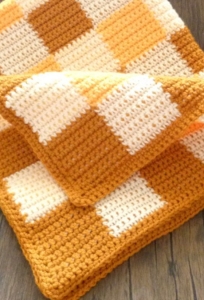
Welcome to Grandma’s Crafts! I’m so happy you stopped by today. I have such a sweet blanket to share with you, especially if you love classic patterns that still feel fresh and cozy. This Baby Plaid Blanket has that beautiful checked look we all recognize, but instead of complicated colorwork, the design is built with simple crochet stitches and carefully placed color changes.
What I liked immediately was how clean the plaid looks once the blocks start forming. The blanket uses three coordinating colors, and each little square is created over a section of 10 stitches and 10 rows. After a few color changes, that familiar plaid pattern begins to appear and the whole blanket suddenly starts making sense.
There is something really charming about plaid for baby projects. It feels traditional without looking old-fashioned, and the colors can completely change the mood of the finished blanket. Soft blue, cream, and green give it a calm nursery look, but I can also imagine this in blush and ivory, beige and sage, or even warmer shades for an autumn baby.
I also love that the stitch pattern itself is simple. The blanket alternates single crochet and double crochet across the rows, so most of your attention can go toward the color changes rather than learning a difficult stitch. Once you get used to switching yarn every 10 stitches, the rhythm becomes much easier.
How the Plaid Pattern Comes Together
The clever part of this blanket is the way the colors alternate in sections. For the first 10 rows, two colors are used across the blanket in 10-stitch blocks. The next 10 rows introduce a different color combination, and repeating those two sections is what creates the plaid effect.
Instead of cutting the yarn every time you change colors, the unused strand can be carried inside the stitches until you need it again. I really like this method for plaid patterns because otherwise you would end up with an impressive number of yarn tails to hide when the blanket is finished.
The pattern works across 130 stitches, with each color section measuring 10 stitches wide. That means you get 13 blocks across the blanket, and the same 10-row structure continues vertically as the plaid grows. The finished sample is approximately 35 by 40 inches, which makes it a lovely size for a baby blanket.
This is also one of those projects where choosing the colors is half the fun. You can keep the middle color consistent throughout the whole blanket and switch the other two shades, or stay with three coordinating colors from beginning to end. A little contrast helps the plaid stand out, but softer shades give it a really gentle and cozy look.
This Baby Plaid Blanket is worked back and forth in rows using three coordinating colors. The plaid effect is created with 10-stitch-wide color blocks and 10-row-tall sections, while the unused yarn is carried inside the stitches as you crochet.
Finished Size
Approximately 35″ x 40″, depending on your yarn, hook size, tension, and border. The source lists this finished measurement with a 4.0 mm crochet hook.
Materials
Light #3/DK baby yarn in three coordinating colors
Color A: Cotton or cream
Color B: Dusk Sky or medium blue
Color C: Jade Frost or soft green
US G/6, 4.0 mm crochet hook
Yarn needle
Scissors
For reference, another version of this same blue, green, and cream plaid color combination uses Bernat Softee Baby Cotton in Cotton, Dusk Sky, and Jade Frost with a 4.0 mm hook.
Gauge
The original page lists:
16 stitches and 20 rows = 4″
with a 4.0 mm hook.
I recommend checking your gauge using the actual alternating sc/dc stitch pattern rather than a plain sc swatch.
Abbreviations
ch = chain sc = single crochet dc = double crochet sl st = slip stitch st(s) = stitch(es) BLO = back loop only rnd = round
Pattern Notes
Ch 1 at the beginning of a row does not count as a stitch.
The blanket body contains 130 stitches.
Each plaid block measures:
10 stitches wide × 10 rows tall
The body is worked for 130 rows, creating a 13 × 13 block plaid.
The basic stitch sequence is:
sc in next st, dc in next st
Because every color block contains 10 stitches, each block ends with a dc. This makes the color changes especially convenient because you can change yarn on the final pull-through of that dc.
How to Carry the Yarn
When you change colors, do not cut the color you will need again in the same row.
Lay the unused strand along the top of the previous row and crochet over it with the working yarn. Keep the carried strand relaxed enough that it does not pull or bunch the fabric.
To change colors at the end of a block, begin the final dc with the current color. When two loops remain on your hook, use the new color for the final yarn over and pull through those two loops.
Drop the previous color, position it along the row, and crochet over it until you need it again.
This type of yarn carrying is a standard technique for plaid and gingham crochet because it allows frequent color changes without cutting the yarn after every block.
Blanket Body
Foundation
With Color A, ch 131.
You will work into 130 chains.
Rows 1–10: Color A and Color B
Row 1
Beginning in the 2nd ch from hook:
Sc in next ch.
Dc in next ch.
Continue alternating sc, dc until you have worked 10 stitches total in Color A.
On the final pull-through of the 10th stitch, change to Color B.
Work the next 10 stitches in Color B, continuing the same sc/dc sequence while carrying Color A inside the stitches.
On the final pull-through of the 10th Color B stitch, change back to Color A.
Continue alternating 10-stitch blocks across:
10 Color A, 10 Color B
Repeat until all 130 stitches have been worked.
Because there are 13 blocks, the row begins and ends with Color A.
130 sts
Ch 1, turn.
Rows 2–10
Continue in the established sc/dc stitch pattern.
Work 10 stitches in Color A, followed by 10 stitches in Color B, changing colors every 10 stitches.
Carry the unused color through the stitches.
Continue across, beginning and ending each row with Color A.
130 sts per row
At the end of Row 10, prepare to begin the next color section.
Rows 11–20: Color B and Color C
Set Color A aside.
Begin this section with Color B and introduce Color C.
Work the first 10 stitches in Color B, alternating sc and dc.
Change to Color C on the final pull-through of the 10th stitch.
Work the next 10 stitches in Color C, carrying Color B inside the stitches.
Change back to Color B after 10 stitches.
Continue alternating:
10 Color B, 10 Color C
across every row.
Because the blanket contains 13 blocks across, each row begins and ends with Color B.
Continue this color arrangement through Row 20.
130 sts per row
Rows 21–30
Return to:
Color A + Color B
Repeat the instructions from Rows 1–10.
Rows 31–40
Work:
Color B + Color C
Repeat the instructions from Rows 11–20.
Continue the Plaid Repeat
Continue alternating the two 10-row sections:
10 rows with Colors A + B
followed by:
10 rows with Colors B + C
Continue until you have completed 120 rows.
Then work one final 10-row section using Colors A + B.
You will finish with:
130 rows total
and approximately:
13 blocks across × 13 blocks high
Fasten off the body yarn and weave in any loose ends.
Important Size Note
This is where I corrected the math from the source.
The original page says the finished blanket contains 11 blocks across and 11 blocks vertically, but ch 131 gives 130 worked stitches, which equals thirteen 10-stitch blocks. Its written row repeat also produces 130 rows, or thirteen 10-row blocks.
If you specifically want an 11 × 11 block blanket, use:
Ch 111 = 110 worked stitches
and stop after:
110 rows
Everything else about the color sequence remains the same.
Border
Use Color A.
Border Round 1
Join yarn in any corner.
Ch 1.
Sc evenly along the first side of the blanket.
At the corner, work:
(sc, ch 1, sc)
Sc across the next edge.
Work (sc, ch 1, sc) in the next corner.
Continue around the entire blanket in this manner.
Along the top and bottom edges, work 1 sc in each stitch.
Along the side edges, space your sc evenly so the blanket lies flat without pulling or ruffling.
Join with sl st to first sc.
Ch 1.
The original border also uses a sc foundation round followed by four rounds worked in BLO.
Border Round 2
Sc in BLO of each sc around.
At each ch-1 corner space, work:
(sc, ch 1, sc)
Join with sl st to first sc.
Ch 1.
Border Rounds 3–5
Repeat Border Round 2.
Continue working each regular stitch in BLO, and work:
(sc, ch 1, sc)
in every corner ch-1 space.
At the end of Round 5, join with sl st.
Fasten off.
Finishing
Weave in all remaining yarn ends.
Gently block the blanket if necessary, especially if the color changes caused any areas to pull slightly.
Lay the blanket flat and make sure the border sits evenly around all four sides.
Once the main blanket is complete, the border adds a nice finishing touch. The pattern uses simple single crochet rounds, with the later rounds worked through the back loop only. That little change gives the border some subtle texture without competing with the plaid design in the center.
I think this would make such a lovely baby shower gift too. Plaid has that timeless quality that works for so many different styles of nursery, and because the blanket is made with a repeating stitch pattern, it is the kind of project you can settle into once the color sequence becomes familiar.
VIDEO TUTORIAL
If you have never tried carrying yarn through your stitches before, just take your time with the first few blocks. Keep the unused strand relaxed as you crochet over it so the fabric stays flat, and after a few color changes you will probably wonder why plaid looked so intimidating in the first place.
I hope you enjoy making this Baby Plaid Blanket and experimenting with your own color combinations. It is simple enough to become relaxing, but the changing blocks keep the project interesting from beginning to end. And as always, thank you for spending a little crochet time here with me at Grandma’s Crafts.