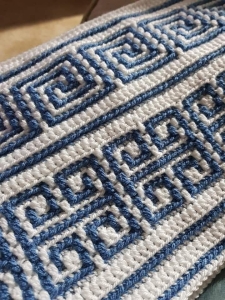
Welcome to Grandma’s Crafts! I’m so happy you are here today. Today we are making a Greek Key Mosaic Crochet. The Greek key is that classic squared spiral you may have seen on old pottery, tiles and border trims, and it looks wonderful worked in two colors of yarn.
Mosaic crochet is perfect for a design like this. You only use one color per row, so there is no carrying yarn and no switching colors in the middle of a row. The pattern comes from one special stitch that reaches down two rows and pulls the dark color up over the light row below. Line those stitches up and the key appears, row by row.
We will use the overlay method, which means every row is worked from the same side. The pretty side is always facing you, so you can watch the key take shape. At the end of each row you cut the yarn, and those tails hide neatly inside the cushion when we put it together.
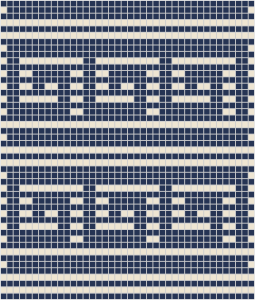
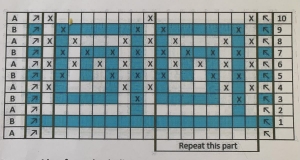
I have written every row out in words, so you don’t need to read a chart. Choose two colors with strong contrast, a dark one for the key and a light one for the background stripes, and let’s begin.
Skill Level
Intermediate. You should be comfortable with single crochet, double crochet and working in the back loop only.
Materials
Worsted weight (#4) yarn in 2 contrasting colors: Color A (dark) and Color B (light). How much you need depends on your cushion size.
5 mm (H-8) crochet hook, or the size recommended on your yarn label
A square cushion form
Measuring tape
Scissors
Tapestry needle
Abbreviations (US Terms)
ch: chain
sl st: slip stitch
sc: single crochet
dc: double crochet
st(s): stitch(es)
yo: yarn over
BLO: back loop only
* *: repeat the instructions between the asterisks as directed
mdc: mosaic double crochet (see below)
edge st: edge stitch (see below)
Special Stitches
Edge stitch (edge st): At the start of a row, place a slip knot of the new color on your hook, insert the hook under both loops of the first stitch and work a sc. At the end of the row, work the last sc under both loops too, then fasten off. Edge stitches keep the sides firm and straight.
Mosaic double crochet (mdc): Yo, insert your hook into the front loop of the stitch two rows below, which is always the same color you are working with. Yo and pull up a loop to the height of the current row, then [yo and pull through 2 loops] twice. The mdc covers the stitch of the row just below it, so skip that stitch. When the pattern says “mdc in each of the next 2 sts”, work 2 mdc going down two rows and skip the 2 stitches of the row below.
Pattern Notes
The number of stitches is a multiple of 12, plus 4. The foundation chain is one more than that: a multiple of 12, plus 5.
All rows are worked with the right side facing you. Do not turn at the end of a row.
Odd numbered rows use Color A (dark) and even numbered rows use Color B (light).
All the even numbered rows are plain rows. The key is made only on the odd numbered rows.
Fasten off at the end of every row and leave a tail of about 6 inches at both ends.
Every row has the same number of stitches. Count them now and then, especially after a row with mdc.
Rows 7 to 26 form the pattern repeat: one band of Greek key with a border line above and below it.
Greek Key Mosaic Crochet Cushion Pattern
Practice Piece and Sizing
Before you start, make a practice piece. Ch 41 with Color A and work Rows 1 to 26 below. You will have 40 stitches, which is 3 repeats of the key. Lay it flat and measure the width, then divide 40 by that number to see how many stitches you get per inch. Multiply by the width of your cushion form and round to the nearest number that is a multiple of 12, plus 4. That is your stitch count, and your foundation chain is one more.
Front Panel
Foundation (Color A): Ch a multiple of 12, plus 5 (ch 41 for the practice piece).
Row 1 (Color A): Sc in the 2nd ch from the hook and in each ch across. Fasten off. (40 sts on the practice piece)
Rows 2 to 6: Alternating colors, B, A, B, A, B: Edge st in the first st, sc BLO in each st across until 1 st remains, edge st in the last st.
Row 7 (Color A): Edge st in the first st, mdc in each st across until 1 st remains, edge st in the last st. This is the bottom border of the key.
Row 8 and every even row up to Row 26 (Color B): Edge st in the first st, sc BLO in each st across until 1 st remains, edge st in the last st.
Row 9 (Color A): Edge st in the first st, sc BLO in each st across until 1 st remains, edge st in the last st.
Row 11 (Color A): Edge st in the first st. *Mdc in each of the next 10 sts, sc BLO in each of the next 2 sts*. Repeat from * across until 3 sts remain. Mdc in each of the next 2 sts, edge st in the last st.
Row 13 (Color A): Edge st in the first st. *Mdc in each of the next 2 sts, sc BLO in each of the next 6 sts, mdc in each of the next 2 sts, sc BLO in each of the next 2 sts*. Repeat from * across until 3 sts remain. Mdc in each of the next 2 sts, edge st in the last st.
Row 15 (Color A): Edge st in the first st. *[Mdc in each of the next 2 sts, sc BLO in each of the next 2 sts] 3 times*. Repeat from * across until 3 sts remain. Mdc in each of the next 2 sts, edge st in the last st.
Row 17 (Color A): Edge st in the first st. *Mdc in each of the next 2 sts, sc BLO in each of the next 2 sts, mdc in each of the next 6 sts, sc BLO in each of the next 2 sts*. Repeat from * across until 3 sts remain. Mdc in each of the next 2 sts, edge st in the last st.
Row 19 (Color A): Edge st in the first st. *Mdc in each of the next 2 sts, sc BLO in each of the next 10 sts*. Repeat from * across until 3 sts remain. Mdc in each of the next 2 sts, edge st in the last st.
Row 21 (Color A): Edge st in the first st, mdc in each st across until 1 st remains, edge st in the last st. This is the top border of the key.
Rows 23 and 25 (Color A): Edge st in the first st, sc BLO in each st across until 1 st remains, edge st in the last st.
Rows 27 and on: Repeat Rows 7 to 26 until the panel is almost as tall as your cushion form, ending after a Row 26. Then work one more plain row with Color A: Edge st in the first st, sc BLO in each st across until 1 st remains, edge st in the last st.
Remember to work each even numbered row in Color B between the odd rows listed above. On the practice piece, every row has 40 stitches.
Back Panel
Foundation: With Color A, ch the same number of chains as the front panel.
Row 1: Sc in the 2nd ch from the hook and in each ch across.
Row 2 and on: Ch 1 (does not count as a st), turn, sc in each st across. Repeat this row until the back panel is the same height as the front panel. Do not fasten off.
Putting the Cushion Together
Tidy the tails: On the front panel, tie the yarn tails at each side edge together in pairs with a small knot and trim them to about 1 inch. They will be hidden inside the cushion.
Join: Hold the back panel behind the front panel with the wrong sides together and the front facing you. Using the yarn still attached to the back panel, work sc through both layers along three sides: 1 sc in each stitch along the top and bottom, 1 sc in the end of each row along the sides and 3 sc in each corner.
Close: Slip the cushion form inside and sc through both layers across the last side. Join with a sl st to the first sc, fasten off and weave the end inside the cushion.
How the Key Appears
If you look at your work after Row 21, you will see that the dark color forms solid lines wherever you worked mdc, while the rest of the fabric shows thin dark and light stripes. The mdc stitches cover the light rows, so the key stands out in dark against the striped background. Each part of the key uses 2 stitches across and 2 rows up, which keeps the squares of the spiral nicely proportioned.
Tips for a Crisp Greek Key
Choose colors with strong contrast. Navy and cream, charcoal and white, or rust and oatmeal all show the key beautifully.
Pull the loop of each mdc up to the height of your row so the fabric stays flat.
Always skip the stitch behind an mdc. If your stitch count grows, you probably worked into it by mistake.
Keep a sticky note on the row you are working. With so many plain rows in between, it is easy to lose your place.
Never turn your work. If the wrong side faces you, turn it back before you begin the row.
VIDEO TUTORIAL
More Ways to Use the Greek Key
Once you know the key, you can use it anywhere. Work a single band across the end of a blanket, make a long narrow strip for a table runner, or repeat the bands all the way up for a bold throw. It also looks lovely as a border on a tote bag.
And there you have it, a Greek Key Mosaic Crochet Cushion that looks like it came straight from a fancy shop! I love how such a classic design comes to life with nothing more than single and double crochet.
Take your time with the first band, and by the second one you will know exactly where every stitch goes. Thank you for crocheting with me today, and come back soon to Grandma’s Crafts for more patterns.