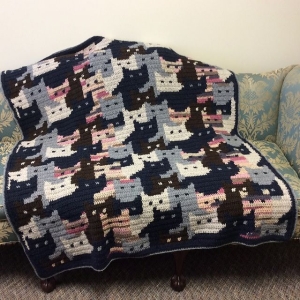
The crochet itself is actually quite straightforward. The original design is worked in double crochet, so the challenge is not learning a complicated stitch. The part that requires attention is keeping track of the color sections while following the chart. The pattern uses a 5.5 mm hook and the original finished size is around 50½ by 54 inches.
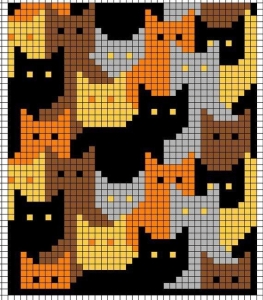
One detail that makes this project much easier to understand is that each square on the original graph represents two double crochet stitches. The cat graph is then repeated across the width of the blanket, creating those rows of colorful silhouettes.
For the color changes, I would definitely recommend preparing several small yarn bobbins before you begin. Instead of dragging one strand across large sections of the blanket, you can keep a separate little ball for each area of color. It may look like a lot of yarn hanging from the back at first, but it keeps the color sections much cleaner.
And please do yourself a favor and enlarge the graph if you can. One crocheter who made this blanket mentioned printing the chart larger and joining copies together to make the design easier to follow. With a project that has this many color changes, being able to clearly see where you are on the graph can make such a difference.
Finished Size
Approximately 50½” x 54″, not including fringe.
Materials
- Worsted weight yarn
- Approximately 18 oz black
- Approximately 15 oz each of:
- US I / 5.5 mm crochet hook, or size needed to obtain gauge
- Yarn needle
- Scissors
- Small yarn bobbins or separate yarn balls are strongly recommended
Gauge
3 dc = 1″
7 dc rows = 4″
Abbreviations
ch = chain
dc = double crochet
sl st = slip stitch
st(s) = stitch(es)
RS = right side
WS = wrong side
Before You Begin
Each square on the color chart represents 2 dc, not one stitch.
The graph is worked twice across every patterned row.
That math checks perfectly:
164 dc total
minus 2 dc at each outer edge = 160 dc
160 dc ÷ 2 dc per graph square = 80 chart squares
Since the graph is repeated twice, each individual cat chart section is 40 squares wide.
This is an important detail because otherwise the stitch count appears not to make sense.
Changing Colors
Work the final yarn over of the stitch before a color change with the new color.
Drop the old color to the WS.
Use a separate ball or bobbin for each individual section of color.
Do not carry yarn across large sections of the row.
That instruction comes directly from the original 1997 pattern.
Blanket
Row 1
With black:
Ch 166.
Dc in 4th ch from hook and in each remaining ch across.
Turn.
164 dc
Row 2
Ch 3.
Dc in next st.
Now begin following Row 2 of the color chart, remembering that:
1 chart square = 2 dc
Work the entire chart once, then immediately work the same chart a second time across the row.
Finish with 1 dc in each of the final 2 sts.
Turn.
The original written Row 2 confirms the first color sequence as black, green, purple, black, red and black before the chart sequence is repeated for the second half of the blanket.
Rows 3–24
Ch 3.
Dc in next st.
Follow the corresponding row of the color chart twice across.
Dc in each of final 2 sts.
Turn.
Rows 25–93
Repeat Rows 2–24 consecutively.
This means the 23-row cat section is repeated vertically until Row 93.
Mathematically, that gives us:
- Rows 2–24 = first 23-row section
- Rows 25–47 = second
- Rows 48–70 = third
- Rows 71–93 = fourth
So the finished blanket contains four stacked repeats of the cat graph, in addition to the solid black beginning and ending rows. This interpretation follows directly from the row numbers in the original magazine pattern.
Row 94
With black only:
Ch 3.
Dc in each st across.
Fasten off.
Fringe
For each fringe group:
Cut 4 strands of black yarn, each approximately 21″ long.
Hold all 4 strands together and fold them in half.
Insert the hook into an edge stitch and pull the folded center through.
Pull all loose ends through the loop and tighten.
Add fringe in every other stitch along both short edges.
Trim evenly when finished.
A Few Tips That Will Make This Much Easier
I would absolutely use small yarn bobbins instead of full skeins for the colored cats. The original construction can leave several colors active at once, and separate bobbins make it much easier to turn the work without everything becoming tangled.
When changing colors, always make the change on the last yarn over of the previous dc. That gives you a much cleaner vertical edge between the black background and the colored cat shapes.
And I would keep the chart beside you at all times. Unlike a normal stitch repeat, the actual cat silhouettes live in that color graph. The written instructions establish the blanket dimensions and colorwork method, but the graph determines where each individual color section begins and ends.
Choosing Colors for Your Cats
This might be my favorite part. The original pattern uses a black background with green, purple, red, and pink cats, but I would have so much fun changing that palette.
You could make every cat a different bright color, use autumn shades for a warmer vintage look, try a sunset palette with orange and gold, or even use softer neutral colors if you want something less bold. I have also seen makers completely reinterpret this design, which shows just how much personality you can give the same basic graph.
The dark background is especially effective because it makes those colorful silhouettes stand out immediately. Add the black fringe at the ends and the whole blanket has that unmistakable retro afghan look that somehow feels fun again today.
This is definitely not one of those projects I would try to finish in a weekend. There are plenty of color changes, and the graph requires a little concentration, but I think that is also part of what makes the finished blanket so satisfying. Even the maker featured by SeeLoveShare described her version as incredibly time-consuming but worth the effort.
DOWNLOAD CATS AFGHAN PDF PATTERN
I think this would make an amazing gift for someone who loves cats, but honestly, I would have a hard time giving it away after spending so many hours watching all those little silhouettes appear. It is one of those blankets that becomes as much a piece of artwork as something you throw over the sofa.
If you decide to try the Vintage Cats Afghan, take your time with the chart, keep those yarn bobbins organized, and enjoy seeing the cats slowly appear with every row. And as always, I’m so happy you stopped by Grandma’s Crafts today. This is exactly the kind of old pattern I love seeing brought back to life.